Selecting the correct size reduction equipment for a testing or research facility frequently involves comparing a planetary mill vs ball mill setup. This comparison starts with an important clarification: a planetary ball mill is actually a highly specialized type of ball mill, whereas the term "ball mill" on its own typically refers to a conventional rotating drum design. Both systems are highly effective, but they serve different roles in laboratory, pilot-scale, and production workflows.
This detailed planetary ball mill vs ball mill guide examines the core differences in grinding motion, force levels, processing volumes, and target particle sizes between these two categories. Understanding these functional differences helps laboratory managers, R&D scientists, and procurement specialists select the configuration that matches their specific applications.
Planetary Mill vs Ball Mill: Quick Comparison
Evaluating these two systems side-by-side helps clarify their physical and operational differences. The table below outlines the primary functional factors for comparing a planetary mill vs ball mill setup to guide your equipment selection.
|
Comparison Factor |
Planetary Ball Mill |
Conventional Ball Mill |
|
Grinding Motion |
Dual-axis counter-rotation (sun wheel and jars) |
Single-axis horizontal rotation (drum or chamber) |
|
Grinding Intensity |
High-energy centrifugal acceleration |
Low-to-medium gravity-driven tumbling |
|
Typical Use Case |
Precision laboratory sample preparation and R&D |
Coarse grinding, pilot mixing, and production scale-up |
|
Sample Volume |
Small to medium batches (milliliters to liters) |
Small batches up to very high industrial tons |
|
Particle Size Reduction |
Outstanding (readily achieves sub-micron ranges) |
Moderate (primarily used for coarse to medium grinding) |
|
Lab Suitability |
High (compact footprint, fast processing) |
Variable (ranges from benchtop rollers to massive drums) |
|
Batch Handling |
Parallel processing with multi-station designs |
Single-batch loading per drum |
|
Wet or Dry Grinding |
Highly suitable for both modes |
Highly suitable for both modes |
|
Process Repeatability |
High (programmable speeds and reversal times) |
Moderate (dependent on gravity and rotation speed) |
|
Footprint |
Compact benchtop or floor-standing units |
Variable (can require dedicated facility structures) |
|
Maintenance & Cleaning |
Manual jar extraction and regular seal checks |
Drum rinsing or pulp discharge |
|
Best-Fit User |
R&D scientists, materials engineers, and QC analysts |
Pilot plant operators and mineral testing technicians |
What Is a Planetary Ball Mill?
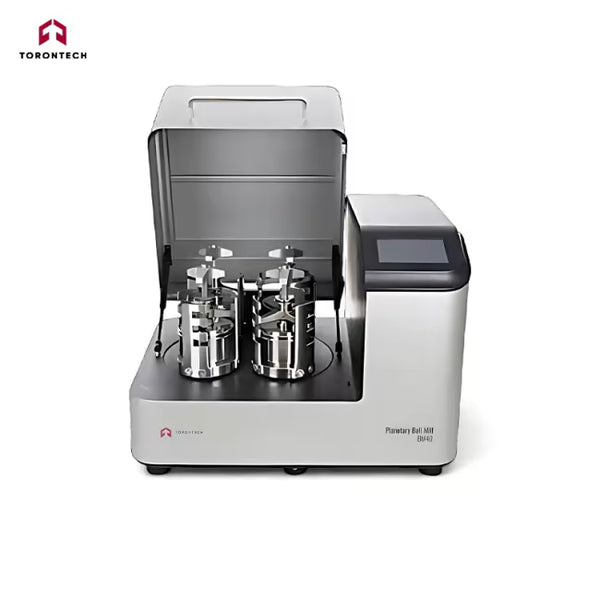
A planetary ball mill is a laboratory grinding mill that utilizes a specialized rotating platform called a sun wheel. Grinding jars are mounted securely on this wheel, and as the platform rotates in one direction, the individual vessels spin in the opposite direction.
This counter-rotational motion generates multidirectional centrifugal forces inside each vessel. This planetary ball mill comparison highlights how this motion path accelerates the grinding media far beyond the limits of standard gravity. The balls detach from the chamber walls and launch across the inner chamber, colliding with the sample with intense impact energy.
What Is a Conventional Ball Mill?
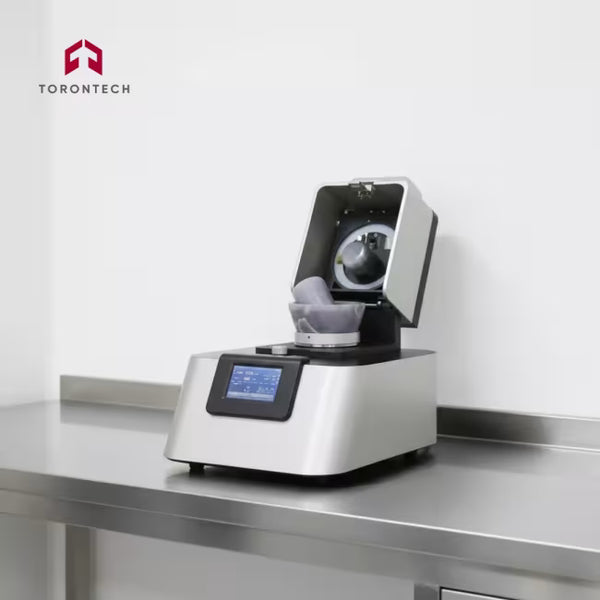
A conventional ball mill operates with a much simpler physical mechanism. The system consists of a horizontal or slightly inclined cylindrical drum loaded with spherical grinding media and the sample material.
Friction between the inner chamber wall and the grinding balls lifts the media upward as the drum rotates on its single horizontal axis. Once the balls reach a certain height, the force of gravity overcomes the frictional lift, causing the media to tumble back down onto the sample material below.
Depending on the scale of your operation, a ball mill machine can be configured as a compact lab ball mill for processing small powder batches, or as a massive industrial ball mill designed for continuous high-volume mineral processing. Gravity limits the maximum rotational speed of these systems, meaning they cannot match the high centrifugal forces generated by planetary motion.
Key Difference 1: Grinding Motion
Rotational kinematics represent the primary physical difference between these two systems. A planetary design spins the grinding jars on their own axes while simultaneously revolving them around a central sun wheel.
A conventional laboratory ball mill rotates on a single horizontal axis. This simpler tumbling action lifts the balls along the curved wall before they cascade downward. Because the media motion in a conventional drum depends entirely on gravity, the maximum energy transfer is physically restricted, making it less suitable for rapid, ultra-fine pulverization.
Key Difference 2: Particle Size Reduction and Grinding Intensity
Centrifugal acceleration drives the grinding media in a planetary mill to high velocities, translating to intense kinetic energy transfer. This force profile combines high-impact collisions with continuous shear stress along the container walls, enabling rapid sample preparation.
Conventional drums rely on gravity-driven tumbling, which applies lower impact forces. While highly effective for coarse size reduction, mixing, and dispersion, conventional gravity mills require significantly longer processing runtimes to achieve fine powder sizes. For demanding workflows requiring sub-micron powder sizes, planetary acceleration is often required.
Key Difference 3: Lab Use and Sample Preparation
Testing laboratories prioritize equipment speed, process repeatability, and contamination control. A planetary ball mill fits cleanly into R&D and quality control environments because it processes small, representative sample batches in minutes.
Selecting a conventional laboratory ball mill is ideal when your testing requires matching the mechanical dynamics of large-scale production equipment. Evaluating diverse laboratory milling equipment options allows technical teams to find the ideal balance between high-energy sample preparation and pilot-scale mechanical modeling.
Key Difference 4: Sample Volume and Throughput
Processing scale dictates whether a planetary or conventional horizontal system is more practical for your facility. Planetary ball mills process small, parallel batches across multiple independent stations, making them ideal for running multi-variable R&D trials simultaneously.
Conventional horizontal mills process larger single-batch volumes inside their spacious cylindrical chambers. If your laboratory needs to prepare kilograms of raw geological material, geological assay standards, or massive pigment slurries, a horizontal drum-style mill provides a more practical, high-capacity solution.
Key Difference 5: Wet Grinding and Dry Grinding
Process liquids can be introduced into both milling designs to assist with size reduction, but they alter the internal dynamics differently. Dry processing is common in both systems for routine sample reduction and powder blending.
In a planetary jar, wet grinding introduces liquid to suspend the particles, preventing electrostatic agglomeration and cooling the sample during high-energy runs. Conventional drum systems often implement continuous wet grinding circuits, feeding liquid suspensions through the drum for steady discharge. Regardless of the machine type, operators must verify the chemical compatibility of all gaskets and vessel linings before introducing liquid solvents.
Key Difference 6: Cleaning, Maintenance, and Contamination Risk
Cross-contamination between successive batches can invalidate spectroscopic or chromatographic data. Planetary systems utilize removable jars that operators can easily extract, empty, and sterilize between testing runs, minimizing sample-to-sample carryover.
Conventional mills feature larger chambers that are more labor-intensive to clean, especially when processing sticky or wet materials. Additionally, the risk of introducing trace wear elements depends heavily on selecting compatible contact materials. Technical teams can select specialized grinding jars and grinding media made of wear-resistant zirconium oxide or tungsten carbide to protect the purity of sensitive samples.
Which Mill Should You Choose?
Selecting the proper equipment requires matching your daily sample throughput with your analytical requirements. The table below outlines common use cases to help technical teams identify the correct physical configuration for their laboratory.
|
Use Case |
Better Fit |
Reason |
|
Planetary Ball Mill |
Centrifugal force is necessary to break down tough minerals down to analytical ranges. |
|
|
R&D Material Testing |
Planetary Ball Mill |
Multi-station configurations allow running parallel trials under identical conditions. |
|
Small-Batch Homogenization |
Planetary Ball Mill |
High-intensity mixing combines micro-additives uniformly within minutes. |
|
Larger Batch Grinding |
Conventional Ball Mill |
Large horizontal drums accommodate several kilograms of raw materials in a single run. |
|
Industrial Scale-Up Workflows |
Conventional Ball Mill |
Horizontal rotating drums match the mechanical dynamics of full-scale production plants. |
|
Contamination-Sensitive Workflows |
Planetary Ball Mill |
Removable jars made of high-purity ceramics are easier to clean and sterilize. |
|
Planetary Ball Mill |
Airtight, pressure-resistant jar seals allow safe solvent-based suspension processing. |
|
|
Routine geological assay checks |
Conventional Ball Mill |
Gentle tumbling action is highly cost-effective for coarse pre-crushing of ore samples. |
When a Planetary Ball Mill May Be Better
Understanding the practical advantages of planetary acceleration helps laboratory buyers justify their instrumentation budgets. A planetary ball mill may be the better choice when your workflow demands:
-
Rapid processing speeds to handle high daily sample counts.
-
Particle size reduction down to the sub-micron range for materials research.
-
Parallel sample preparation across multiple independent stations under identical parameters.
-
High-intensity mixing of trace additives into cohesive powder mixtures.
-
A compact benchtop footprint that fits easily within limited laboratory bench space.
When a Conventional Ball Mill May Be Better
A conventional horizontal mill remains a highly reliable, cost-effective tool across many material processing facilities. A standard drum-style mill may be the better choice when your workflow requires:
-
Processing large single-batch volumes that exceed standard laboratory jar capacities.
-
Gentle tumbling and blending of sensitive paint pigments, ceramic glazes, or ink slurries.
-
Simpler mechanical operation with fewer electronic programming options.
-
Low replacement accessory costs and straightforward maintenance procedures.
-
Replicating full-scale industrial grinding dynamics for pilot plant modeling.
Questions to Ask Before Choosing
Procurement teams and quality control managers should review these physical and operational questions before selecting a size reduction system:
-
What raw material will be processed, and what is its Mohs hardness?
-
What is the starting feed size, and does it require pre-crushing?
-
What is the target particle size distribution needed for downstream testing?
-
Is wet grinding, dry grinding, or inert gas operation required?
-
What is the average sample volume processed in a single operational run?
-
Is the workflow focused on rapid R&D testing or high-volume batch processing?
-
How important is precise parameter repeatability between operator shifts?
-
What trace contamination limits apply to our final analytical samples?
-
Are the required jar, chamber, and grinding media materials compatible with our target chemistry?
-
How much cleaning time is acceptable between successive material runs?
-
What physical bench space, voltage, and phase requirements apply to our facility?
Final Recommendation
Choosing between a planetary mill and a conventional rotating drum depends on balancing target particle size, processing volume, and required kinetic energy. A planetary ball mill remains the standard for high-energy, laboratory-scale sample preparation where sub-micron uniformity and speed are necessary. Conversely, conventional rotating drums provide a highly cost-effective approach for larger batch mixing, pilot scale-up, and coarse material processing.
The manufacturer ToronMed offers high-performance size reduction systems engineered to withstand demanding laboratory workflows.
Talk With Our Team About Choosing the Right Lab Mill
Sourcing precise testing instrumentation requires matching material properties with stable machine configurations. If you are comparing laboratory milling equipment, evaluating jar wear materials, or require guidance on equipment validation, our application specialists are ready to assist. Speak with the ToronMed technical team today to discuss your target sample dimensions, throughput goals, and analytical constraints to identify the appropriate equipment configuration for your workflow.