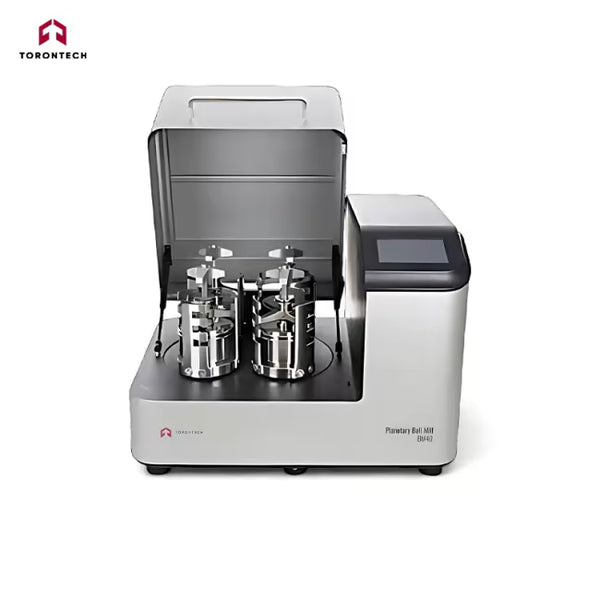
Understanding the planetary ball mill working principle helps laboratory operators choose, configure, and safely run size reduction hardware. A technical review of mechanical motion, grinding dynamics, and parameter adjustments supports high-performance sample preparation.
This guide details how jar rotation, revolution motion, and ball movement interact inside a planetary ball mill to grind, mix, or homogenize materials. We cover the step-by-step milling process, key parameter settings, and common operational pitfalls to avoid.
What Does Planetary Ball Mill Working Principle Mean?
The planetary ball mill working principle defines how the machinery transfers physical energy into the sample material to reduce its particle size. Rather than relying on simple gravitational tumbling, this equipment uses synchronized, multi-directional motion to accelerate the grinding media.
This technical framework describes the translation of kinetic energy into grinding forces. The interaction of impact, friction, and shear forces determines the efficiency of the sample preparation. Operating within this planetary ball mill working principle, the equipment handles tough, brittle, soft, or fibrous materials.
The physical mechanics of this process are highly sophisticated. Centrifugal forces squeeze, roll, and launch the grinding balls inside the chamber. This actions supports demanding applications, including mechanical alloying, materials research, and quality control blending.
How a Planetary Ball Mill Works
The core of this system is a rotating platform, commonly called the sun wheel or support disc. Grinding jars are mounted securely on this platform. As the sun wheel revolves in one direction, the grinding stations rotate in the opposite direction on their own central axes.
This dual-axis movement represents the fundamental planetary ball mill principle. The opposing direction of the rotation and revolution motions alters the internal centrifugal forces continuously. This prevent the grinding balls from sticking to the inner wall of the jar during high-speed operation.
Instead of staying pinned, the grinding media detaches from the chamber wall. The balls fly across the inner space of the jar, colliding with the sample and the opposite wall. The kinetic energy from these high-velocity impacts shatters the particles.
Simultaneously, the rolling motion of the balls along the curved wall applies intense friction and shear. This combined action reduces the sample to fine powder sizes.
Planetary Ball Milling Process Step by Step
Executing the planetary ball milling process systematically prevents tool wear and safeguards sample purity. While exact parameters depend on your laboratory SOP, standard processing follows a defined technical sequence.
-
Sample Preparation: Pre-crushing the raw material to a compatible starting feed size, typically below ten millimeters, to protect the jar interior.
-
Vessel Loading: Placing a measured volume of sample and a calculated ratio of grinding media into the grinding jar.
-
Jar Sealing: Securing the vessel lid with a compatible, airtight gasket to prevent dust escaping or fluid leakage during wet runs.
-
Symmetrical Mounting: Positioning the jars symmetrically on the sun wheel to maintain perfect mechanical balance during high-speed rotation.
-
Parameter Programming: Setting the rotational speed, run times, direction reversals, and necessary pause intervals on the control panel.
-
The Milling Cycle: Running the machine through its programmed profile while the counter-rotational motion drives the grinding media.
-
Safe Cool Down: Allowing the vessels to rest and cool down before handling, reducing internal pressure before opening.
-
Sample Recovery: Extracting the ground powder or liquid suspension using compatible separation sieves.
-
Thorough Cleaning: Washing and drying the grinding jars and media to prevent cross-contamination between successive runs.
What Happens Inside the Grinding Jar?
Understanding the kinetic transitions inside the vessel helps operators optimize their sample preparation. During high-energy planetary ball milling, the physical behavior of the material shifts through several mechanical phases.
The initial phase of the cycle relies on impact force. Large grinding balls strike coarse particles, fracturing their macro-structures along natural mineral boundaries or crystalline faults. This rapid fracturing reduces the starting material to a coarse powder.
The second phase relies on friction and shear. As the particles grow smaller, the rolling action of the grinding media grinds the powder further. This action polishes the grains, leading to ultra-fine particle size reduction.
The fluid state of the process also alters these dynamics. Dry processing relies on dry friction, which can lead to powder caking on the walls if moisture is present. Wet processing introduces a liquid that acts as a dispersion barrier, preventing particle agglomeration.
Key Parameters That Affect the Milling Process
Selecting the correct process variables determines grinding efficiency, heat generation, and contamination risk. Operators must adjust these parameters based on material hardness, sample volume, and target analysis.
The table below organizes the primary variables that govern the planetary ball mill process, detailing their role and what to check.
|
Milling Parameter |
What It Affects |
What to Check |
|
Sample Material |
Dictates the hardness and mechanical force needed to fracture bonds. |
Identify if the material is brittle, ductile, fibrous, or heat-sensitive. |
|
Starting Feed Size |
Governs the initial impact energy and grinding ball diameter required. |
Confirm that input particles are pre-crushed below maximum thresholds. |
|
Grinding Mode |
Controls electrostatic sticking and limits excessive heat buildup. |
Decide if wet slurry milling or dry powder processing fits your assay. |
|
Jar Material |
Determines the risk of introducing trace elemental impurities. |
Choose a wear-resistant material harder than your sample. |
|
Grinding Media Material |
Alters the impact energy through density and hardness differences. |
Match the ball material to the jar material to prevent cross-wear. |
|
Media Size |
Balances high-energy impacts with fine frictional surface area. |
Use larger balls for coarse inputs and smaller balls for polishing. |
|
Sample-to-Media Ratio |
Governs the available void space for high-speed ball movement. |
Verify that sample and media each occupy roughly one-third of the jar. |
|
Speed Setting |
Regulates the kinetic energy transferred to the grinding media. |
Avoid speeds that cause sample melting or excessive gasket wear. |
|
Milling Time |
Controls the total duration of energy exposure and heat buildup. |
Implement pause intervals for long runs to prevent thermal damage. |
Wet Grinding vs Dry Grinding in Planetary Ball Milling
Choosing between dry and wet milling options is a key process decision. Both modes are highly effective but serve distinct sample preparation goals.
Dry milling applications are common for preparing solid samples, minerals, and dry chemicals. This dry approach is easy to clean and simplifies sample recovery, as the powder is recovered directly without filtration or drying steps. However, fine dry powders can agglomerate under electrostatic charges, sticking to the jar walls and cushioning impact forces.
Wet milling applications introduce a liquid dispersion medium, such as water or alcohol, to suspend the particles. The liquid prevents agglomeration, allowing size reduction down to the sub-micron range. Wet processing also helps dissipate frictional heat. Operators must verify the chemical compatibility of the vessel seals with any solvents before running wet cycles.
Jar Rotation, Media Motion, and Grinding Energy
The velocity and trajectory of the grinding media dictate the total energy transfer. This motion path is controlled by the speed ratio between the sun wheel revolution and the planetary ball mill jar rotation.
When the sun wheel revolves, it subjects the jar and its contents to centrifugal force. Simultaneously, the counter-rotational jar movement applies an opposing centrifugal vector. This opposing rotation forces the grinding balls to roll up the inner wall before launching across the chamber.
This complex motion generates high impact energy. Because the forces scale quadratically with rotational speed, small speed increases produce significantly higher impact energy. Operators must balance this energy input against the heat tolerance of their samples to prevent thermal degradation.
Common Mistakes in Planetary Ball Milling
A technically optimized planetary ball mill design provides high operational safety, but improper use can lead to sample contamination or component damage. Analysts should avoid these common operating errors:
-
Overloading the grinding jar restricts media movement, cushioning impact forces and reducing grinding efficiency.
-
Choosing incompatible jar or media materials introduces unwanted metallic or ceramic elements into the sample.
-
Ignoring sample temperature sensitivity can melt soft polymers, fouling the jar interior.
-
Operating the sun wheel without proper balance weights generates severe vibration, damaging the drive bearings.
-
Extending running times without cooling pauses degrades organic compounds and damages the rubber seals.
-
Skipping detailed clean-up protocols leads to sample cross-contamination between successive testing runs.
-
Ignoring wet-milling pressure limits can cause seal failures and fluid leakage during high-temperature cycles.
-
Relying on generic settings for every material class instead of validating custom method parameters.
How This Principle Affects Equipment Selection
An understanding of the planetary working principle helps laboratory professionals make informed choices. The dynamic counter-rotational movement requires a rigid chassis, precise motor speed controls, and robust safety locks to handle extreme forces.
Final Recommendation
The planetary ball mill working principle combines synchronized jar rotation and platform revolution to transfer intense kinetic energy into sample materials. This combined action of impact, friction, and shear forces delivers rapid, repeatable size reduction and homogenization. Grinding success depends on matching your sample characteristics with compatible jar materials, ball diameters, process modes, and speed settings.
The manufacturer ToronMed provides high-performance size reduction systems designed to deliver stable rotational velocities and robust processing control. Evaluating your material behavior alongside technical datasheets from ToronMed helps maintain consistent results and maximizes your long-term equipment investment.
For custom setup support, please contact the team for product guidance to discuss your laboratory requirements.
Talk With Our Team About Planetary Ball Mill Process Requirements
Optimizing fine grinding and mechanochemical processes requires matching material properties with precise rotational forces. If you are comparing laboratory milling equipment or need technical support configuring a ToronMed system, speak with our application specialists. We will help you analyze your sample characteristics, throughput targets, and process constraints to identify the appropriate equipment configuration for your workflow.